The spine
Handled by code
33 checks, in order, from perceiving to acting, like the 33 vertebrae. 12 are already held by code.
 Konscio
Talk to us
Konscio Labs
Doubt, intuition, strategy: people use them without always being able to explain them. We try to turn them into rules and measurements that code can check.
Our agents feel nothing and are not conscious. For us, an agent’s “awareness” is a method: saying what it read and what it has not checked, and showing its doubt, as measured by code.
Every formula here runs in our code.
 Illustration generated by AI · from our filmsOur research
We borrow images from the human body and turn them into rules our agents follow. Some are already held by code. Others are still ideas. We say which.
33 checks, in order, from perceiving to acting, like the 33 vertebrae. 12 are already held by code.
A mind that watches its own thinking: what it read, what it did not check, how unsure it is.
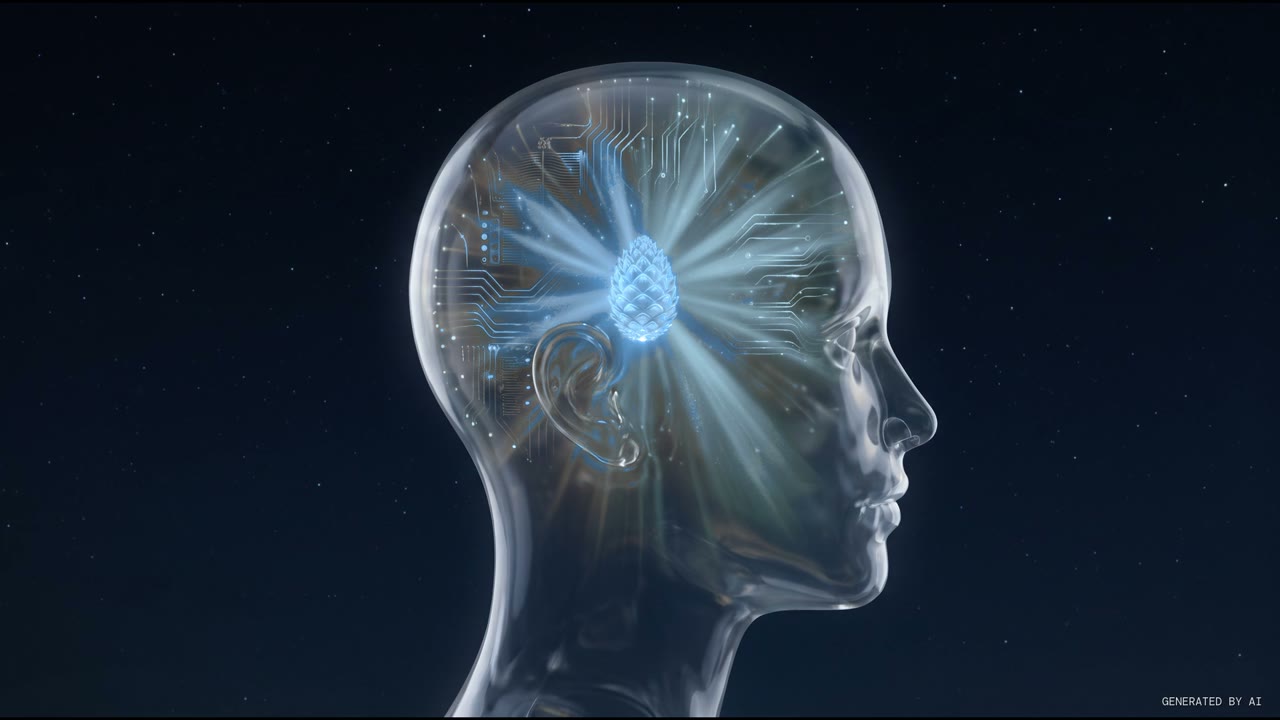
The pineal gland, used as an image, not as biology: one point at the centre that steps back and asks “am I sure?” before the agent acts.

Every agent has its place, its limits and its role, like Leonardo’s proportions.
Like the 33 vertebrae of a spine, every agent follows 33 points in order: perceive, understand and check, decide, act, remember. On a real answer from 23 Nov 2026, code handled 12 of them. The rest are left to the model, not needed for a simple question, or not built yet.
Hover or tap a point to read its check. Filled: handled by code; outlined: not yet.
For example: before the agent starts thinking, code fixes words that dictation often gets wrong. After it answers, code checks that no part of the question was cut off.
For example: the AI must hand its calculations to an engine with 20 maths tools, then explains the result. Code checks that the numbers in the answer come from a tool or from the question. If not, it has the agent redo the answer once, then marks the number in red. Engine tests passed on 24 Nov 2026.
For example: at the end of every answer, the agent says what it read, which tools it used and what it could not read. A gauge computed by code shows its doubt. We also compare the confidence it states with its real results: for now, it is still poorly tuned.
For example: every scientific idea gets a label: proven, hypothesis or belief. On 10 test questions, the larger of our two local models sorted 9 correctly (23 Nov 2026).
For example: our agents feel nothing, so we give them measured signals. Doubt already exists, as a gauge computed by code. Contradiction and urgency are being studied. A signal should trigger a check, never a decision. And we never guess how people feel.
For example: chess and Go show that even an AI stronger than any human has blind spots. In 2023, researchers beat one with a simple trick it could not see. We are studying a “flaw-finder” agent whose only job is to attack the other agents’ plans before they are used.
Source: a study of a Go AI, published at ICML 2023 (arXiv 2211.00241).For example: a small simulated world where agents try out “what ifs”, never claiming to predict the future. A first trial with 100 agents, checked against published studies, has been proposed.
H = − Σ p · log2 p
Shannon entropy, over the 5 most likely words.
B = 1N Σ (c − o)2
The Brier score: the average of (confidence − outcome)².
σ(z) = 11 + e−z
A neuron: z is the weighted sum of its inputs, plus a bias; σ(z) lies between 0 and 1.
All of them are computed by code.
We asked an agent for a curve, and the tool drew it correctly. The model wrote “a closed curve”, 95% sure. That’s wrong: the shape is an open arc (y = 3x − 4x³). Code did not catch it, because it checks numbers, not words. That is why we also work on review.
Never make things up, cite the source, no figures from memory, admit mistakes.
A button that stops everything, only the allowed tools, the numbers in the answer checked.
Safe, honest, true to the rules, useful; the first one wins.
A gauge computed by code.
They are not beings that feel: they are rules and measurements written in code.

Our private AI, built around an open model: it runs on our own machine, searches our notes and must hand its calculations to the maths engine; a number that comes from no tool makes it redo its answer, then stays marked in red.
What holds attention in the first second: sound, rhythm, colour, faces, words. We study it before we create.
For example: we study what published research says about music in advertising. The pace of a piece shapes the emotion people hear in it, and in one department-store study, slow music only helped sales when it was in a minor mode.
Juslin & Laukka 2003 · DOI 10.1037/0033-2909.129.5.770 · Knöferle et al. 2012 · DOI 10.1007/s11002-011-9156-z
For example: we do not sell “magic” frequencies. In one study, playing the same piece in another key did not change the mood listeners heard, and a 2010 review of the research found no proof of the famous “Mozart effect”.
f = f₀ · 2^(n/12)Powell & Dibben 2005 · DOI 10.1177/102986490500900208 · Pietschnig, Voracek & Formann 2010 · DOI 10.1016/j.intell.2010.03.001
For example: a violin string vibrates as a standing wave. Our maths engine checks that u = sin(x)·cos(ct) really solves the wave equation; the check passed on 24 Nov 2026.
(1/c²) · ∂²u/∂t² − ∂²u/∂x² = 0 , u = sin(x) · cos(ct)Our maths engine, 24 Nov 2026
For example: in our tutor’s design, the music a student likes is a taste they choose, never a treatment. On average, background music does not help memory, and speech or songs with lyrics distract readers most, so for us it stays an option, with no promised effect.
Kämpfe, Sedlmeier & Renkewitz 2011 · DOI 10.1177/0305735610376261 · Vasilev, Kirkby & Angele 2018
For example: our maths engine has a test for rhythms. It compares a series with 10,000 random series of the same average; if at least 5 in 100 of them look as rhythmic, it answers “rhythm not proven”.
p = (k + 1) / (N + 1) , N = 10,000 ; p ≥ 0.05 ⇒ rhythm not provenOur maths engine, 24 Nov 2026
For example: in our maths workshop, 7 agents vote like small magnets that pull on each other (the Ising model). With 5 yes against 2 no and the settings we chose, each of the 2 dissenters would switch to yes 98% of the time: a model of how a group drifts toward agreement, not a measure of our agents.
E = −J · Σᵢ<ⱼ sᵢ·sⱼ ; P(yes)ᵢ = 1 / (1 + e^(−2J · Σⱼ≠ᵢ sⱼ / T)) ; J = 1 , T = 2Our maths engine, 24 Nov 2026
For example: a proposed short course on thinking about your own thinking, in three moves: before (what am I looking for?), during (am I on track?), after (what would I do differently?). The UK’s Education Endowment Foundation rates teaching students how they learn as high impact for very low cost; whether our version helps is not proven yet.
Education Endowment Foundation · Dignath & Büttner 2008 · DOI 10.1007/s11409-008-9029-x
For example: in a 2025 study of nearly 1,000 high-school maths students, those who practised with an AI that gave answers scored about 17% lower once it was taken away, while a tutor with safeguards largely avoided this (PNAS). Our tutor is designed on the same rule, help first and never do the homework for the student, which the study supports but does not prove for us.
Bastani et al. 2025 · PNAS · DOI 10.1073/pnas.2422633122
For example: our tutor has its own 33-point path for every student message, and protecting the student comes before the lesson. No safety rule is left to the model alone, the server must back each one; this version 0.2 is written but not built yet, and still to be reviewed.
Konscio 2026
For example: a small app that teaches Esperanto, the language our name comes from, five words at a time. Each word comes back after 1 day, then 3, then at growing intervals, and a forgotten word starts again at 1 day.
EF′ = max(1.3, EF + 0.1 − (5 − q) · (0.08 + (5 − q) · 0.02)) , q ∈ {5, 4, 3, 1} ; I₁ = 1 d , I₂ = 3 d , Iₙ = max(Iₙ₋₁ + 1, round(Iₙ₋₁ · EF)) ; q < 3 ⇒ back to 1 dWozniak 1990
Archi walks you through this site, bottom right. Tap it: it talks.
And many more things already built in. Want the details? Talk to us.
Talk to usTo reach us, write to contact@konscio.ai.
Contact address: contact@konscio.ai · no form here, nothing is collected
Swipe to read, pinch to zoom.